Situlated Creative Practices for the Pluriverse (SIT-PLU)
Creative Europe (CREA-CULT-2004-COOP-2)
PhD. Anna Pujadas & Mar Saiz

nebula
«A nebula is a cloud of star remnants where new stars are often formed. They can be emission nebulae (they shine by the light of nearby stars), reflection nebulae (they reflect the light of stars) or dark nebulae (they are only seen as black spots). Until the beginning of the 20th century, the term nebula was applied to all celestial objects of diffuse appearance, which with the telescopes of the time, could not be resolved into individual stars.»
Elijah J. Burritt, Clusters, Nebulae, and Comets, New York, 1856 circa
https://www.raremaps.com/

collserola park
«When, five years ago, the Serra de Collserola Natural Park was created, it incorporated several situations, such as that of Nebuloses Street, where half of the houses have remained inside the park. Hortènsia Duran, from the Association of Residents with Urban Affectations of Les Planes, explains that ‘the park boundary passes right through the middle of the street.’».
Map of the boundaries of the Serra de Collserola Natural Park
https://www.3cat.cat/324/

corine map
«The Corine Land Cover (CLC) map is a project of the European Environment Agency. The CLC is based on the interpretation of satellite images (Landsat, SPOT) to identify land cover and its use. Although it is based on remote sensing, it is a photointerpretation project, not an automated classification, and its main purpose is to facilitate decision-making in matters of territorial policy within the European Union.»
https://es.wikipedia.org/wiki/
Map of CORINE habitats of the Serra de Collserola Natural Park
https://www.ub.edu/geoveg/

habitat
«The biogeographic attributions it gives are neither complete nor exclusive, so that, if interpretative logic so advises, they can be expanded.
And on this point it insists that the presence of a habitat outside its main biogeographic area has an added value, emphasizing the interest of this type of azonal environments.»
Report on the correspondences between the habitats of Catalonia and the habitats of community interest, UB, 2018, p. 5
Map of habitats of community interest in the Serra de Collserola Natural Park
https://parcnaturalcollserola.cat/habitats/
Mar Saiz & Anna Pujadas
To go out to pasture
This practice takes as its starting point an activity rooted in the territory of Collserola and in the specific context of EINA: sheep and goat herding. This activity serves as a means to explore the territory through its modes of movement, dwelling, and care. The practice proposes “becoming a herd” as a collective experience, intertwined with the practice of drawing. This involves developing an awareness of, and critically and creatively designing, one’s own act of drawing, as well as its processes and outcomes. Samples from the land will be collected in the manner of a herd, and the practice will engage with the legacy of previous projects, such as Tornen les Esquelles.
Pastoral Drawing: A Situated Drawing Practice of Collection
This situated practice consists of walking through the terrain while carrying or dragging a piece of felt, allowing it to come into contact with the ground, vegetation, and surrounding elements. As the body moves, the felt functions as a collecting surface, gathering fragments such as seeds, dust, plant matter, fibers, and traces of the landscape. The act of walking becomes a form of slow grazing, echoing the movements of sheep as they pasture and traverse the land.
In this sense, participants are invited to move like a flock, attuning their pace, direction, and attention to the terrain. What adheres to the felt is not randomly gathered but collected through contact and coexistence, shaped by friction, pressure, and duration. The felt operates as an extension of the body, a porous membrane that registers the territory through accumulation rather than extraction.
After the walk, the materials collected on the felt become the basis for drawing. These drawings are not representations of the landscape but traces of what has been encountered and gathered, transforming acts of pastoral movement and care into visual form. The practice emphasizes drawing as a process of recollection and translation, where what is obtained has been pastured, carried, and held, much like the residues of a shared journey across the land.
AUTHOR Mar Saiz

Images by Mar Saiz

Images by Mar Saiz

Images by Mar Saiz
Stitching the Trace: Collective Embroidery and Shared Care
This associated practice focuses on the transfer of the previously collected drawings onto a piece of tarlatan fabric, reclaimed from disuse in the printmaking workshop. The choice of tarlatan introduces a logic of reuse, residue, and care, extending the life of a material marked by prior gestures and labor.
The drawings are transferred onto the fabric through processes that emphasize contact, pressure, and permeability, allowing images to appear as imprints rather than fixed representations. Once transferred, the drawings are collectively embroidered onto the tarlatan. This embroidery process unfolds as a shared, slow, and repetitive action, where individual gestures merge into a collective rhythm.
Working together, participants embroider like a flock, without a hierarchical structure, guided by proximity, attention, and mutual support. Threads, stitches, and hands move across the fabric in a coordinated yet open manner, echoing the dynamics of herding and collective care. Through this process, the drawings become thickened, repaired, and sustained by the group, transforming fragile traces into a communal textile surface that holds memory, time, and shared effort.
AUTHOR Mar Saiz

Images by Mar Saiz

Images by Mar Saiz

Images by Mar Saiz
Creative Infographics from Pastoral Walk
This situated practice invites participants to walk through the terrain as a form of pastoral movement, attuning their bodies and senses to the environment, much like a flock grazing. As they move, they collect information about sounds, movements, people, objects, sensations, and emotions—not as abstract data, but as lived, embodied experience. The act of walking becomes a method of observation, listening, and sensing, where the participants themselves are instruments of perception, and the environment responds to their presence.
Rather than recording in a conventional way, the collected information emerges from direct engagement with the landscape and its inhabitants, capturing traces of interactions, rhythms, and affective atmospheres. The focus is on attention, coexistence, and the relational dynamics of moving together through space.
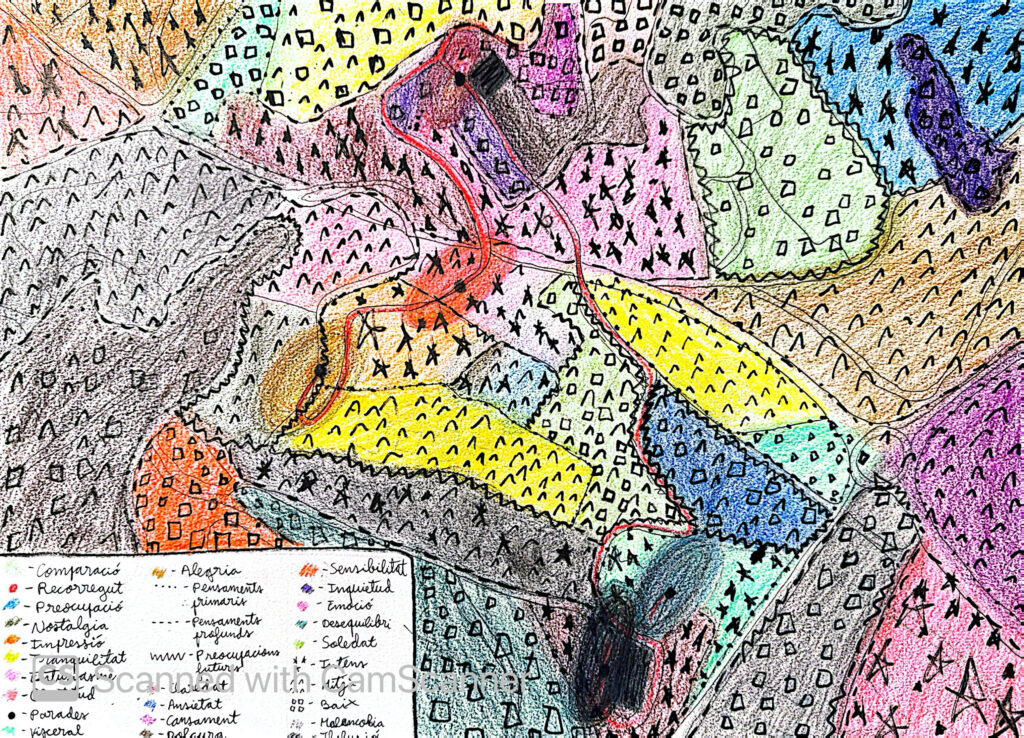
Work by Marina Alba Freixas
Once the walk is complete, the gathered information is translated into a creative infographic, transforming ephemeral, sensory, and emotional data into a visual, tangible representation. This process emphasizes collective synthesis and interpretation, revealing patterns, flows, and relationships that would otherwise remain invisible. The practice thus turns walking into a tool for research, reflection, and creative visualization, highlighting how experience, memory, and affective engagement can be mapped and shared.
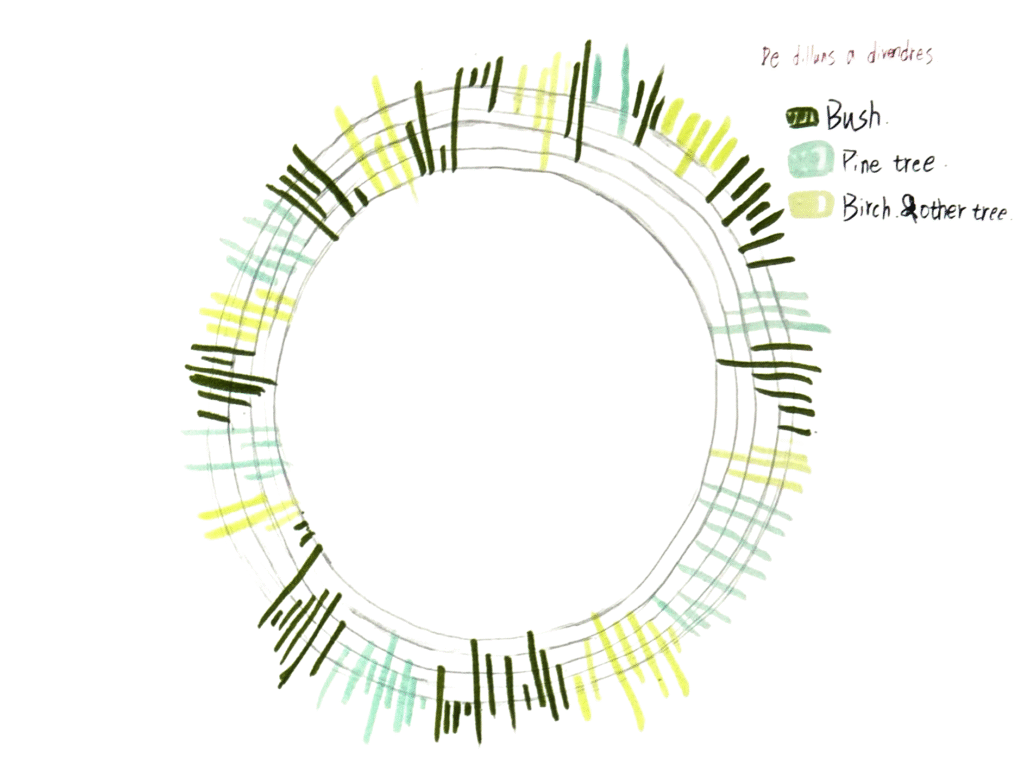
Work by Zimeng Song
Mar Saiz & Anna Pujadas
Drawing hand-to-hand with the territory
This practice encourages an intimate, respectful, and tactile approach to drawing, understood not merely as a technical skill but as a relational and embodied process. Through shared gestures, proximity, and attentive presence, drawing becomes a space where bodies, materials, and diverse forms of knowledge intertwine. The practice fosters an environment of collective creation, emphasizing care, listening, and mutual responsibility. By engaging with difference—of bodies, experiences, and perspectives—, it invites participants to rethink drawing as a collaborative act that generates connection, sensitivity, and shared meaning.
Caressage
It is a hand-to-hand drawing methodology where a transfer is created through contact between the body of the artist and the thing being drawn. Its predecessors are frottage and grattage. AUTHOR Mar Saiz
Caressage performance by Mar Saiz. Video by A. Pujadas.

Caressage drawing by Mar Saiz
Transfer emerges through direct bodily contact between the artist and the subject being drawn. Rather than relying solely on visual observation, the drawing process is activated by touch, pressure, movement, and proximity, allowing information to pass from body to body. The artist’s hand becomes a mediating surface, registering textures, temperatures, rhythms, and resistances. Through this embodied exchange, drawing functions as a trace of physical encounter, where the boundaries between observer and observed are softened, and knowledge is produced through corporeal experience and sensory transmission.

Images by Mar Saiz
Mar Saiz & Anna Pujadas
Choreocartography
“Choreocartography” is an activity developed by Laboratori Nebula connected to the research line SIT-PLU (Situated Creative Practices for the Pluriverse). The proposal begins with a situated approach to the territory surrounding the university, understood not only as a physical space but also as an ecosystem of relationships, memories, uses, and tensions between the natural environment and the institutional context.
The project takes walking, observation, and embodied exploration as methodological tools to activate a critical and sensory reading of the landscape. Through a series of walks around the campus, specific fragments of the territory (paths, edges, slopes, vegetation, traces of human presence, or geological formations) are selected and digitally captured in three dimensions using the Scaniverse application. The 3D scans were produced by Helena Giménez, generating a collection of digital records that document the topography and textures of the site from a situated and experiential perspective.
Film by Helena Giménez, Mar Saiz & A. Pujadas.
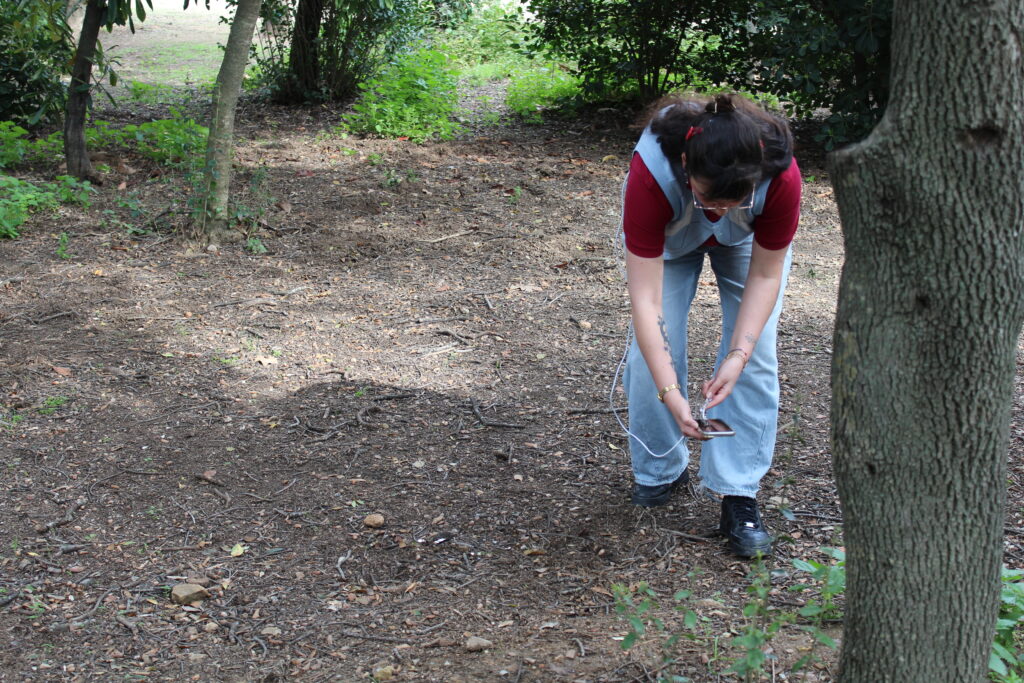
Image by Mar Saiz
These materials were later processed and transformed into an audiovisual film by Mar Saiz and Anna Pujadas, where the different scans are assembled into a moving cartography. The resulting piece does not seek to offer an objective or scientific representation of the territory, but rather a choreographic and speculative reading of the landscape: a way of understanding the terrain as a living, mutable, and relational body.
Choreocartography therefore proposes an intersection between artistic practices, digital technologies, and situated ecologies, opening new ways of representing and inhabiting territory. The project understands cartography not as a fixed tool of delimitation, but as a performative process capable of revealing invisible narratives, latent movements, and alternative forms of knowledge connected to place.
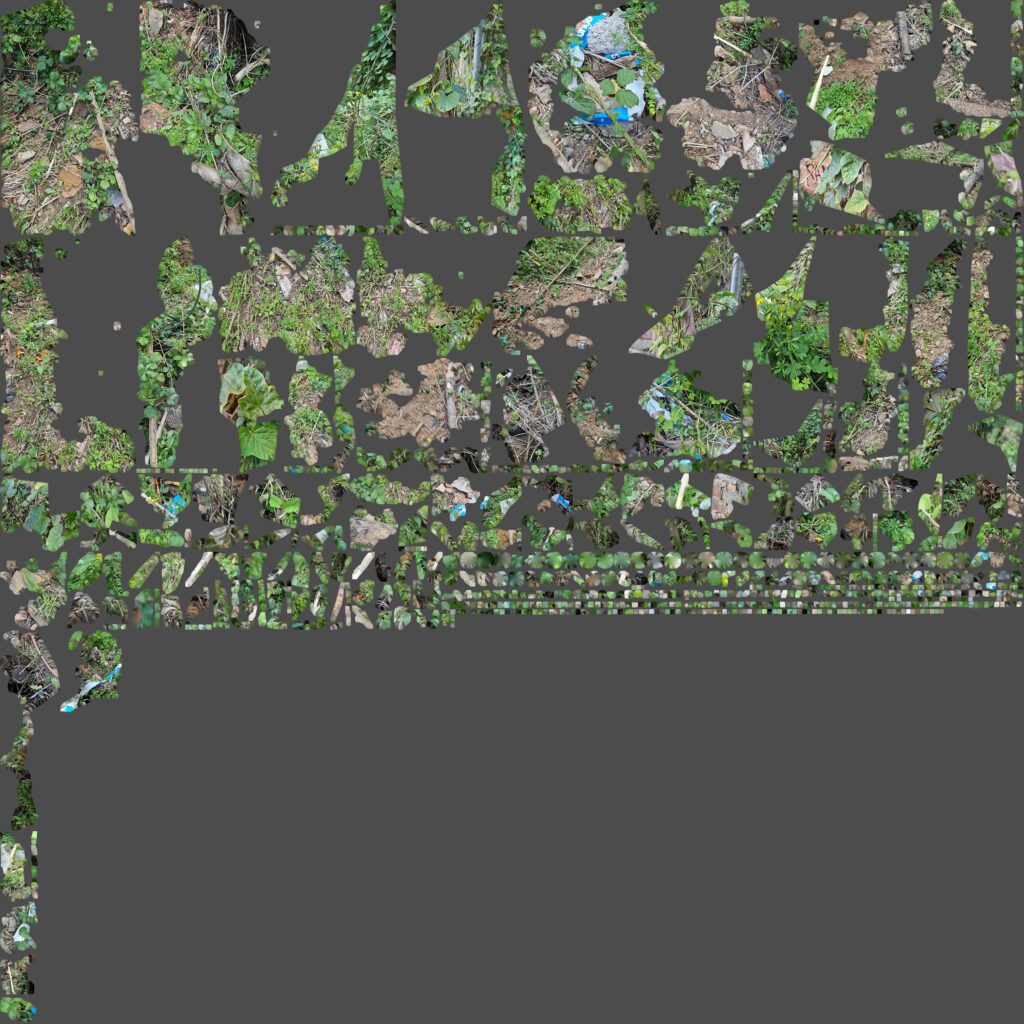
Imagesby Helena Giménez
Mar Saiz & Anna Pujadas
Loving an edaphic world
Appreciating a soil world. Take as models of human interaction the non-human interactions of the territory. Researching the substrate, the physical layers. The natural environment in which the organism lives, and the surface or medium on which the organism grows or is attached. The traces and the earthy material itself.
Video by A. Pujadas
CLICK THIS LINK AND EXLORE WITH THE MAGNIFYING GLASS!
https://annapujadas.cat/cure_care/convolucio/